The next generation of skin longevity products will be defined by delivery science — not ingredient novelty alone.
NAD⁺ has become one of the most important themes in longevity science.
It is central to cellular energy, mitochondrial function, DNA repair and many of the biological processes associated with ageing, repair and resilience. As interest in NAD⁺ biology has grown, so has interest in NAD⁺ precursors — including nicotinamide mononucleotide (NMN), nicotinamide riboside (NR) and nicotinamide, also known as niacinamide or NAM.
This has created a new and exciting category in skincare: topical NAD⁺ precursor products positioned around skin longevity rather than simply cosmetic anti-ageing.
But topical skincare has a very specific challenge.
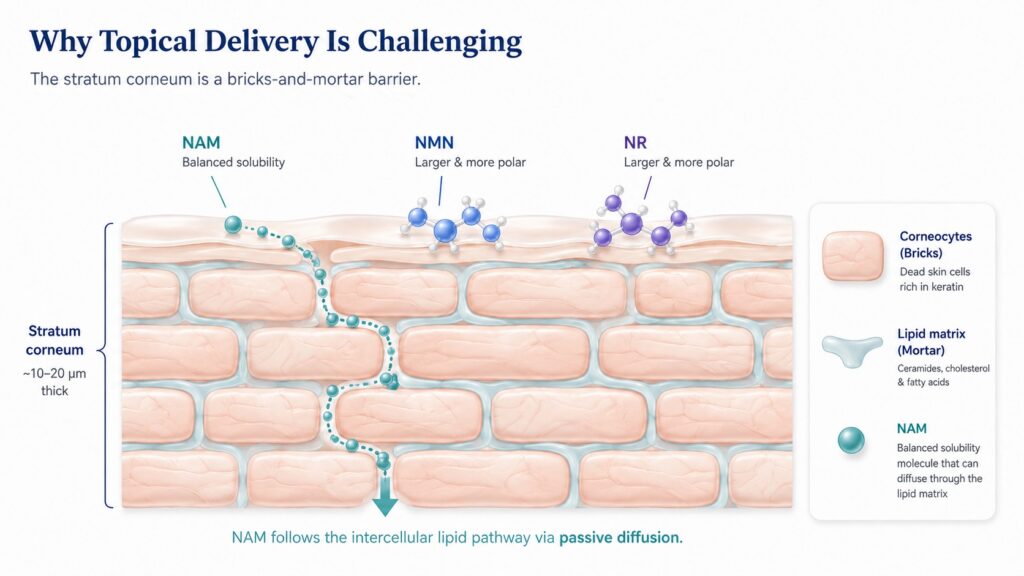
It is not enough for an ingredient to have exciting biology. It must first permeate to the target site, at the right concentration, and remain there for long enough to have a meaningful biological effect. This principle has shaped topical dermatology for decades: an active must not only be biologically relevant; it must also be delivered effectively to its target site and sustained over the dose interval.
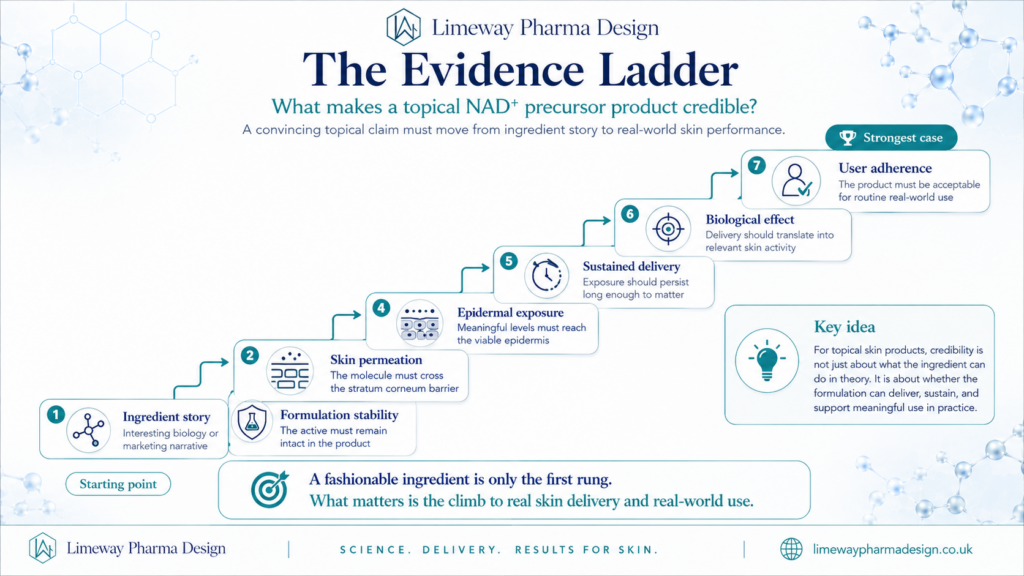
That is the difference between a compelling ingredient story and a credible topical technology.
For topical NAD⁺ skincare, the most important question is not simply:
Which NAD⁺ precursor has the most exciting biology?
It is:
Which NAD⁺ precursor can be delivered into the skin in a controlled, sustained and biologically meaningful way?
Why oral NAD⁺ science does not automatically translate to topical skincare
| Oral NAD⁺ precursor | Topical NAD⁺ precursor |
|---|---|
| Gut | Skin barrier |
| Liver metabolism | Stratum corneum permeation |
| Systemic circulation | Local epidermal exposure |
| Whole-body dosing | Targeted skin delivery |
Much of the current excitement around NMN and NR comes from oral supplementation science.
When taken orally, NAD⁺ precursors enter the body through the digestive system and are processed through systemic metabolism. Their absorption, distribution and cellular uptake involve biological pathways, transport systems and metabolism across the gut, liver, blood and tissues.
Topical delivery is very different.
For an active ingredient applied to the skin, the first challenge is not systemic metabolism. It is the stratum corneum — the skin’s outer protective barrier.
The stratum corneum is highly selective. It is often described as a “bricks and mortar” structure, where corneocyte cells form the bricks and lipid layers form the mortar. To reach viable epidermal cells, a molecule must pass through this barrier, usually by passive diffusion.
That process is influenced by several key factors, including molecular size, polarity and the balance between water and lipid solubility.
This matters because an NAD⁺ precursor may be biologically relevant once inside a cell, but still be poorly suited to passive movement through the skin barrier and into the cell.
The topical challenge for NMN and NR
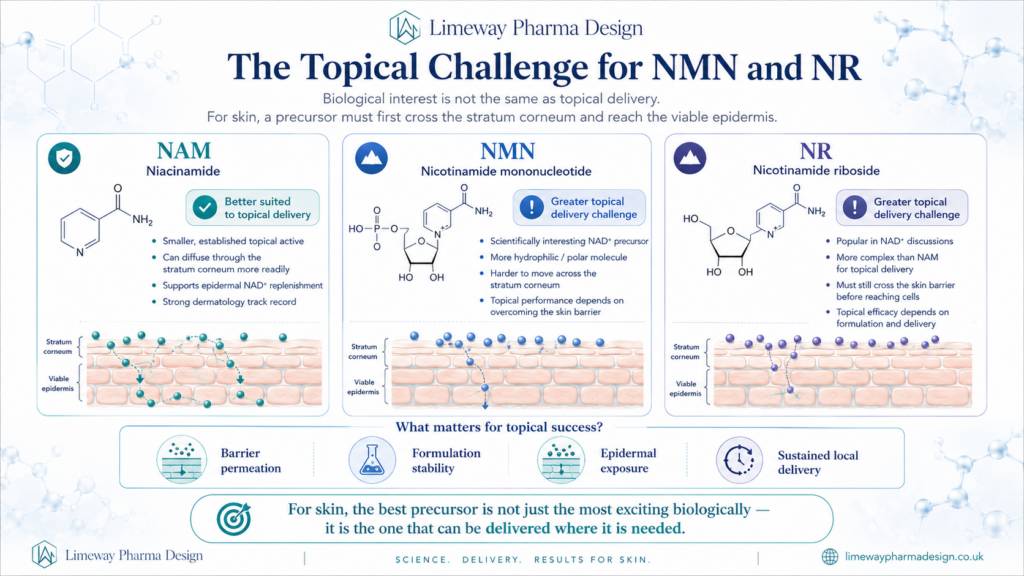
NMN and NR have helped bring NAD⁺ biology into mainstream skincare conversations. They are scientifically interesting molecules and have an important place in the wider NAD⁺ field.
However, their suitability for topical skincare should not be assumed from oral or systemic data.
NMN and NR are relatively polar molecules. This creates a practical challenge for passive diffusion through the lipid-rich stratum corneum. Predictive skin permeation modelling suggests that NMN may be substantially less permeable through skin than nicotinamide.
That does not mean NMN or NR have no biological relevance. It means that topical formulation claims need to be supported by topical delivery evidence.
For skincare, the relevant questions are:
Can NMN or NR cross human skin in meaningful quantities?
Can they reach the viable epidermis?
Can they remain available for long enough to influence NAD⁺ biology?
Can the formulation remain stable over time?
Until these questions are answered by robust human skin permeation and pharmacology data, topical NMN and NR should be viewed as promising but technically challenging ingredients.
Stability matters too
Delivery is not the only issue. Stability is also important.
A topical product must remain chemically and physically stable throughout its shelf life. If an NAD⁺ precursor degrades in the formulation, the consumer may not receive the ingredient, dose or biological effect promised on the label.
This is particularly relevant for NMN, which is known to be vulnerable to hydrolysis and degradation under certain conditions. If a formulation relies on complex delivery systems to protect or transport a polar molecule, any change in composition over time could affect both stability and skin delivery.
For the future of skin longevity, this matters.
The category will only build trust if products combine compelling biology with pharmaceutical-quality formulation thinking.
Why nicotinamide deserves renewed attention
Nicotinamide, or niacinamide, is sometimes seen as less exciting than newer NAD⁺ precursors.
But from a topical delivery perspective, it remains highly relevant.
Nicotinamide is smaller than NMN and better suited to passive diffusion through the skin barrier. It is also one of the best-established actives in dermatology and cosmetic science, with benefits associated with skin barrier support, pigmentation, inflammation and visible skin quality.
It is also a physiological NAD⁺ precursor.
This combination makes nicotinamide particularly interesting for topical NAD⁺ skincare. Its advantage is not novelty. Its advantage is practicality.
In skin longevity, the winning ingredient may not be the newest precursor. It may be the precursor that can be delivered most effectively to the target site.
From ingredient marketing to delivery-led skincare
The skincare market often moves quickly toward the newest and most fashionable ingredient.
That is understandable. Ingredient stories are easy to communicate. They create excitement. They help consumers connect skincare to broader wellness and longevity trends.
But skin biology is not changed by novelty alone.
For topical NAD⁺ products, the real test is whether a formulation can deliver a precursor into the epidermis in a controlled and sustained way.
This is where the category needs to mature.
The next generation of NAD⁺ skincare should be judged not only by the biological relevance of the precursor, but by evidence that the formulation can:
- cross the stratum corneum;
- achieve meaningful epidermal exposure;
- sustain delivery over the dose interval;
- remain stable in the finished product;
- offer a positive user experience that supports daily use.
This is the foundation of credible skin longevity.
The central question for topical NAD⁺ skincare
NAD⁺ biology has opened an important new conversation about skin health.
It has moved the discussion beyond surface-level anti-ageing and toward cellular energy, DNA repair, UV resilience, barrier function and long-term skin quality.
But for topical products, biology must be matched by delivery.
The most important question is not whether NAD⁺ precursors are biologically interesting. They are.
The question is whether they can be delivered into the skin in a way that is sustained, targeted and meaningful.
That is why topical NAD⁺ skincare needs more than a good story.
It needs delivery science.
In Part 2, we explore why Limeway Pharma Design has focused on enhanced and sustained epidermal delivery of nicotinamide — and how this approach could help define the next generation of skin longevity products.